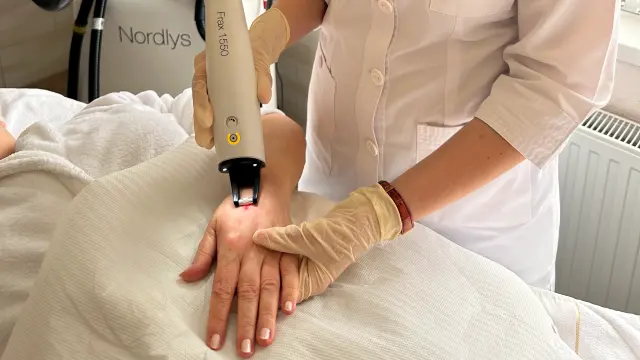
Photoaging encompasses the skin changes that occur as a result of prolonged and cumulative exposure to ultraviolet radiation. They develop gradually and most commonly become visible in areas regularly exposed to the sun, such as the face, neck, décolletage, forearms, and hands.
Over time, the skin can become drier and rougher, lose some of its elasticity, and develop fine lines, wrinkles, an uneven skin tone, and pigmented spots. These changes manifest with varying intensity in different people and are often combined.
The degree of photoaging depends on the accumulated UV exposure over the years, the phototype, individual skin sensitivity, and the photoprotection used.
What is photoaging?
Skin changes with age under the influence of both natural biological processes and external factors. Photoaging is a form of externally induced aging in which chronic exposure to ultraviolet radiation plays a primary role.
UV rays affect various structures in the skin. Over time, changes in collagen and elastic fibers can occur, as well as disruptions in melanin production and distribution.
This explains why photoaging does not manifest with wrinkles alone. It can simultaneously affect skin density, elasticity, texture, and color.
How does photoaging manifest?
Photoaging can simultaneously affect the color, texture, and structural characteristics of the skin.
Among the most common manifestations are:
-
uneven skin tone and areas of altered pigmentation;
-
sunspots or age spots;
-
drier and rougher texture;
-
fine lines and more pronounced wrinkles;
-
reduced elasticity;
-
visible superficial blood vessels in some individuals.
The changes are usually most pronounced in areas with the most prolonged sun exposure.
Which areas most frequently show signs of photoaging?
The face is one of the first areas where people notice changes, but photoaging is not limited to it alone.
The neck and décolletage are also exposed to a significant amount of UV radiation and can gradually develop uneven pigmentation, textural changes, and a loss of elasticity.
The backs of the hands and forearms frequently show accumulated sun damage through the appearance of pigmented spots and changes in skin quality. This is precisely why professional procedures for photoaging often target not only the face, but also the décolletage and hands.
What is the relationship between photoaging and pigmented spots?
Prolonged UV exposure can lead to the uneven production and accumulation of melanin. One of the characteristic manifestations is solar lentigines, frequently referred to as sunspots or age spots.
These usually appear as flat, well-defined brownish areas and are found primarily in chronically sun-exposed zones.
In photoaging, individual pigmented spots and a more general unevenness of skin tone are often present simultaneously.
Find out more about pigmentation spots
How does photoaging affect skin tone and texture?
Accumulated sun exposure can gradually disrupt the even distribution of pigment. As a result, the complexion can appear more blotchy, non-uniform, or feature distinct lighter and darker areas.
Changes also occur in the skin's structure. Damage to collagen and elastic fibers can manifest as a rougher surface, reduced density, a loss of elasticity, and more visible lines.
Because these changes frequently develop simultaneously, the approach to photoaging can target more than one aspect of the condition.
Find out more about uneven skin tone
Can photoaging be prevented?
Consistent photoprotection is a fundamental part of preventing premature changes associated with sun exposure. It helps limit the accumulation of new UV damage and delays the appearance of pigment changes, an uneven skin tone, a loss of elasticity, and other signs of photoaging.
Daily use of a broad-spectrum sunscreen should be combined with a reasonable limitation of prolonged exposure to strong sunlight, especially during hours of highest UV intensity.
When signs of photoaging are already pronounced, photoprotection remains an important part of the overall approach. It helps maintain the results of professional procedures and reduces the risk of deepening or recurring pigment changes.
Can the signs of photoaging be improved?
With appropriately selected professional procedures, various manifestations of photoaging can be addressed, including pigment changes, an uneven skin tone, a rough texture, and certain changes related to skin quality and elasticity.
The choice of method depends on which changes are primary. For more pronounced pigmentation, approaches targeting pigment alterations can be discussed. When changes in skin tone, texture, and overall quality are present simultaneously, a combined approach may be necessary.
At DERMA ART, options for photoaging include, for example, Light & Bright for the face and décolletage, and photorejuvenation for the face, hands, and arms. For certain conditions, depigmenting peels, Exion Clear RF, or professional therapies targeting skin quality and pigmentation may also be discussed.
The appropriate procedure and treatment sequence are determined individually according to the phototype, treatment area, type of changes, and skin condition.
Consultation at DERMA ART
If you notice pigment changes, an uneven skin tone, a loss of elasticity, or other signs of photoaging and are unsure which approach is right for your skin, you can take the first step in a way that is convenient for you.
Use the virtual consultation to explore procedures based on your primary goals and preferences, or book a consultation appointment at DERMA ART if you desire an individual assessment of your skin condition and a specialist's recommendation.
Suitable Procedures for Photoaging
Professional procedures are selected according to the leading manifestations of photoaging, the treatment area, the phototype, and the overall condition of the skin.
For pigmentation and an uneven skin tone, light-based, laser, or depigmenting methods can be discussed. When changes in texture, density, and elasticity are also present, the plan may include procedures aimed at skin renewal and improving its quality.
The information on this page is for informational purposes only and does not replace an individual medical examination, diagnosis, and recommendations from a physician.